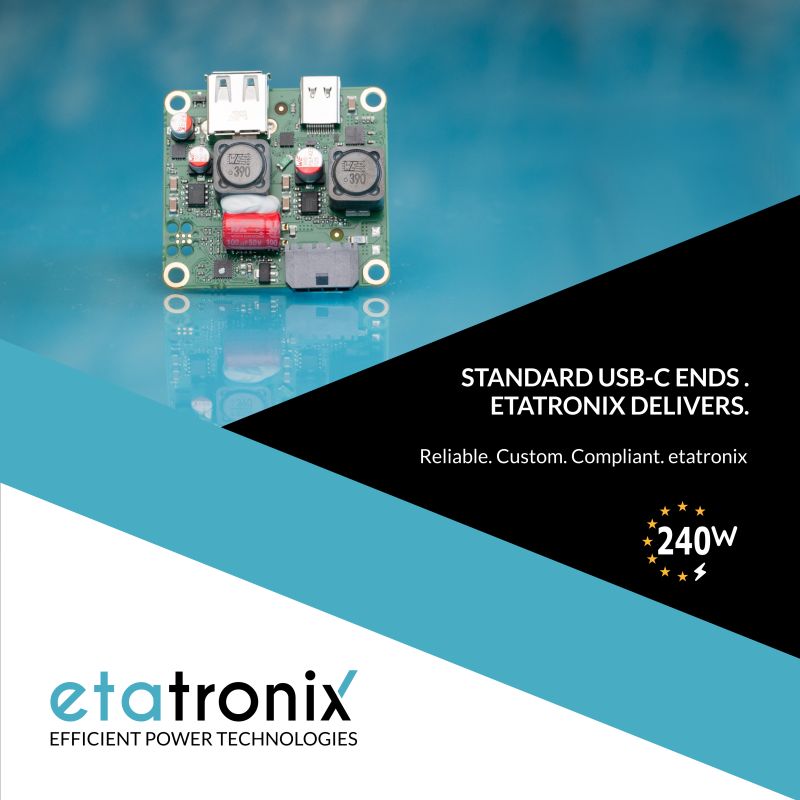
Why USB‑C is a system-level topic in industrial and medical applications
USB‑C has become the standard. Many developments therefore start with an off-the-shelf USB‑C controller and its reference design. What is often missing is a view of the entire power subsystem behind the port: AC/DC and DC/DC converters, battery and battery management, installation space, heat, safety and EMC.
Typical pitfalls
- Insufficient system performance or unsuitable voltage levels
- Low efficiency with consequences for heat and EMC
- Compatibility and compliance issues that only surface late in development
- Limits of standard modules in tight spaces, harsh environments or with requirements such as EMC, the Low Voltage Directive or ATEX
Specific requirements in medical technology
Medical devices demand high reliability, long life cycles and compliance with IEC 60601‑1. For hygiene-critical devices, we combine USB‑C with wireless power transfer so that the enclosure stays sealed and easy to clean.
Our approach
- The complete power subsystem from a single source: AC/DC, DC/DC, battery management, wireless charging and USB Power Delivery per USB PD 3.1 up to 240 W
- Voltages and power levels tailored to the application, including proprietary charging profiles
- Cost optimization across volume and product life cycle
- Development through series production, so you can focus on your core product