

How much power can be transferred wirelessly?
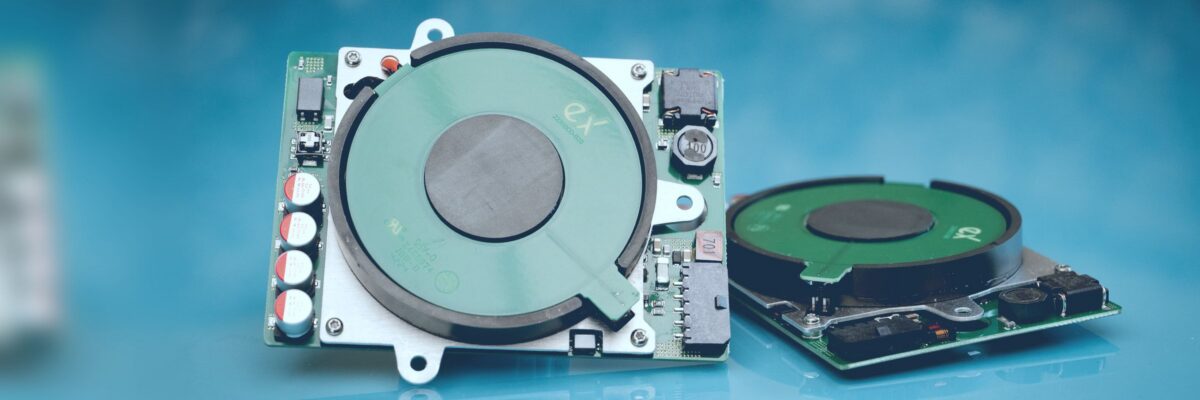
From a few milliwatts up to the kilowatt range. Our focus is on power levels up to 3.6 kW. However, there is no fixed limit. For applications with higher demand, we design the system accordingly.
To get started, our exm modules from 10 W to 1000 W are available as a ready-made standard solution.
Learn more: exm Series: Wireless Power Modules from 10 W to 1000 W
Over what distance does the transfer work?
This depends mainly on the size of the coils. Compact systems with small coils bridge up to about 8 mm. Larger coils allow larger distances and higher power levels.
We design the coil geometry to match the installation space, distance and power.
Learn more: Near-Field Power Transfer 2013
How efficient is wireless power transfer?
Efficiency depends on the transferred power. Our high-power systems achieve more than 95 %, which is close to wired solutions. We also keep standby losses low.
Learn more: Near-Field Power Transfer 2013 and A New Figure of Merit 2014
Does the transfer work through housings, water or dirt?
Yes. Power can be transferred through plastic, glass, water and dirt without any problem. Since no exposed contacts are needed, devices can be fully sealed, for example for use under water or in hazardous areas.
Electrically conductive materials between the coils are difficult. Eddy currents form in them, which reduce efficiency or make efficient transfer impossible. Foreign object detection (FOD) protects against heating caused by metal parts.
Can data be transferred in addition to power?
Yes. For status information, we use our own method over the same transfer path, in both directions. For higher data rates, we use parallel radio links such as Bluetooth or Wi-Fi. For very high data rates, there are systems with optical data transfer in the Gbit/s range.
Learn more: Broadband Data Link
What radio approvals does a wireless power system need?
Wireless power transfer generates alternating magnetic fields. That is why every system requires radio approval. In the EU, it is based on the Radio Equipment Directive (RED) with EN 303 417 and EN 300 330, in the US on FCC rules and in Canada on RSS-216.
Depending on the data transfer path, further approvals are required. Bluetooth and Wi-Fi in the 2.4 GHz band, for example, require EN 300 328, Wi-Fi in the 5 GHz band EN 301 893. With optical data transfer, no radio approval is needed for the data path.
We have already supported worldwide product launches and obtained the necessary approvals.
What about EMC and safety for people?
We transfer power in the magnetic near field. The field stays confined to the small area between the transmitter and receiver coils and decays rapidly with increasing distance. As a result, very little energy is radiated.
We verify electromagnetic compatibility and compliance with the limits for human exposure through EMC and SAR measurements.
Are your systems Qi compatible?
Our exm modules are not Qi compatible. They deliver significantly higher power and offer more powerful data transfer. This allows them to charge batteries and also operate as a power supply.
For projects that require Qi compatibility, we have already developed custom transmitters and receivers.
Why wireless instead of a connector?
Wireless power transfer does not wear out, because no contacts are plugged in. Housings stay fully sealed, and no sparks occur when connecting. This is an advantage in wet, dirty or hazardous environments. Operation is also simple: put the device down, done.
What power ranges do you develop?
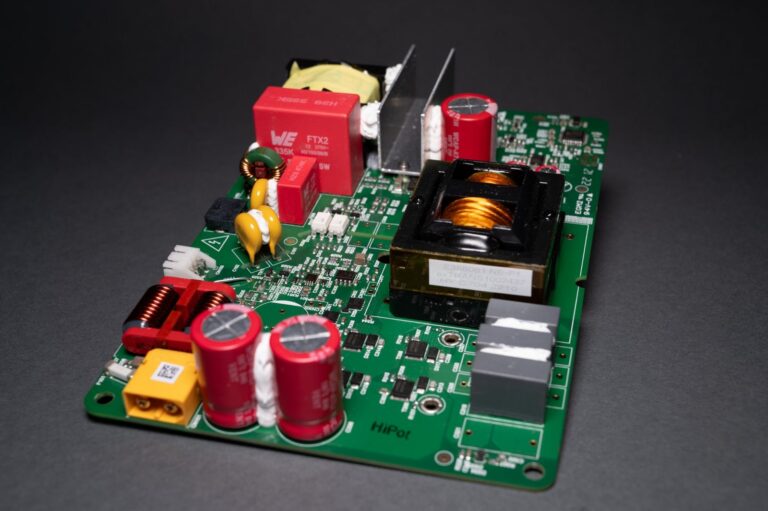
AC/DC power supplies, DC/DC converters, inverters (DC/AC) and chargers, plus batteries with battery management systems. There is no lower limit, because even low power often has to be provided very efficiently.
At the upper end, as with wireless power, our focus is on power levels up to 3.6 kW.
Learn more: Tech Insights: Baseplate Cooling for Rugged Power Supplies
Do you also develop batteries and battery management systems?
Yes. We develop the charger, battery and battery management system (BMS) individually or as a system, for any cell chemistry and form factor. The BMS monitors state of charge (SoC) and state of health (SoH), protects the cells and communicates via SMBus, I²C or CAN. For safety and transport, we design the battery in accordance with IEC 62133–2 and UN 38.3.
Are there standard products or only custom developments?
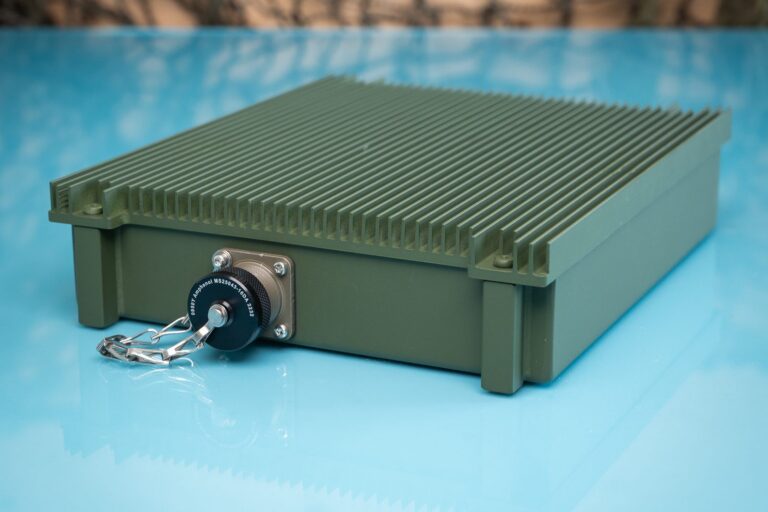
Both. The RPS series of rugged power supplies and the exm wireless power modules are standard products, which we adapt to customer requirements as needed. Beyond that, we develop fully custom solutions.
Pre-developed hardware platforms and firmware building blocks shorten development time.